
Conference Interpreting
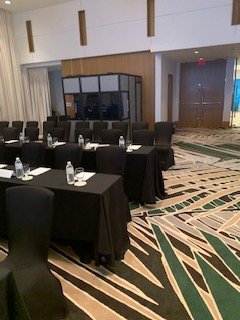
Conference interpreting refers to interpretation at a conference or large meeting, either simultaneously or consecutively on-site, off-site or hybrid.
Conference interpretation is divided between two markets: institutional and private. International institutions (EU, UN, EPO, et cetera), which hold multilingual meetings, often favor interpreting several foreign languages into the interpreters’ mother tongues. Local private markets tend to have bilingual meetings (the local language plus another), and the interpreters work both into and out of their mother tongues. These markets are not mutually exclusive. The International Association of Conference Interpreters (AIIC) is the only worldwide association of conference interpreters. Founded in 1953, its membership includes more than 2,800 professional conference interpreters, in more than 90 countries.
On-Site Legal Interpreting
Judicial, legal, or court interpreting occurs in courts of justice, administrative tribunals, and wherever a legal proceeding is held (i.e., a police station for an interrogation, a conference room for a deposition, or the locale for taking a sworn statement). Legal interpreting can be the consecutive interpretation of witnesses’ testimony, for example, or the simultaneous interpretation of entire proceedings, by electronic means, for one person, or all of the people attending. In a legal context, where ramifications of misinterpretation may be dire, accuracy is paramount. Teams of two or more interpreters, with one actively interpreting and the second monitoring for greater accuracy, may be deployed.

Conference Equipment
Conference equipment is used from small reunions to massive congresses to aid both speakers and listeners in communicating. These often involve audio systems, interpreting systems, power supply management, and video projection.

Immigration Interpreter

Immigration interpreting is used in formal citizenship, immigration, and naturalization hearings all over the United States, in a variety of languages representing the diversity of immigrants to the United States.
Court Interpreter
Judicial, legal, or court interpreting occurs in courts of justice, administrative tribunals, and wherever a legal proceeding is held (i.e., a police station for an interrogation, a conference room for a deposition, or the locale for taking a sworn statement). Legal interpreting can be the consecutive interpretation of witnesses’ testimony, for example, or the simultaneous interpretation of entire proceedings, by electronic means, for one person, or all of the people attending. In a legal context, where ramifications of misinterpretation may be dire, accuracy is paramount. Teams of two or more interpreters, with one actively interpreting and the second monitoring for greater accuracy, may be deployed.

Business Interpreter

Business interpretation involves all sorts of environments and modalities: from one-to-one meetings to focus groups to sight translations of documents. It often involves a more personal take than conferences.
Certified Translations
A certified translation is one which fulfills the requirements in the country in question, enabling it to be used in formal procedures, with the translator accepting responsibility for its accuracy. These requirements varies widely from country to country. While some countries allow only state-appointed translators to produce such translations, others will accept those carried out by any competent bilingual individual. Between these two extremes are countries where a certified translation can be carried out by any professional translator with the correct credentials (which may include membership of specific translation associations or the holding of certain qualifications).

 ConFluent